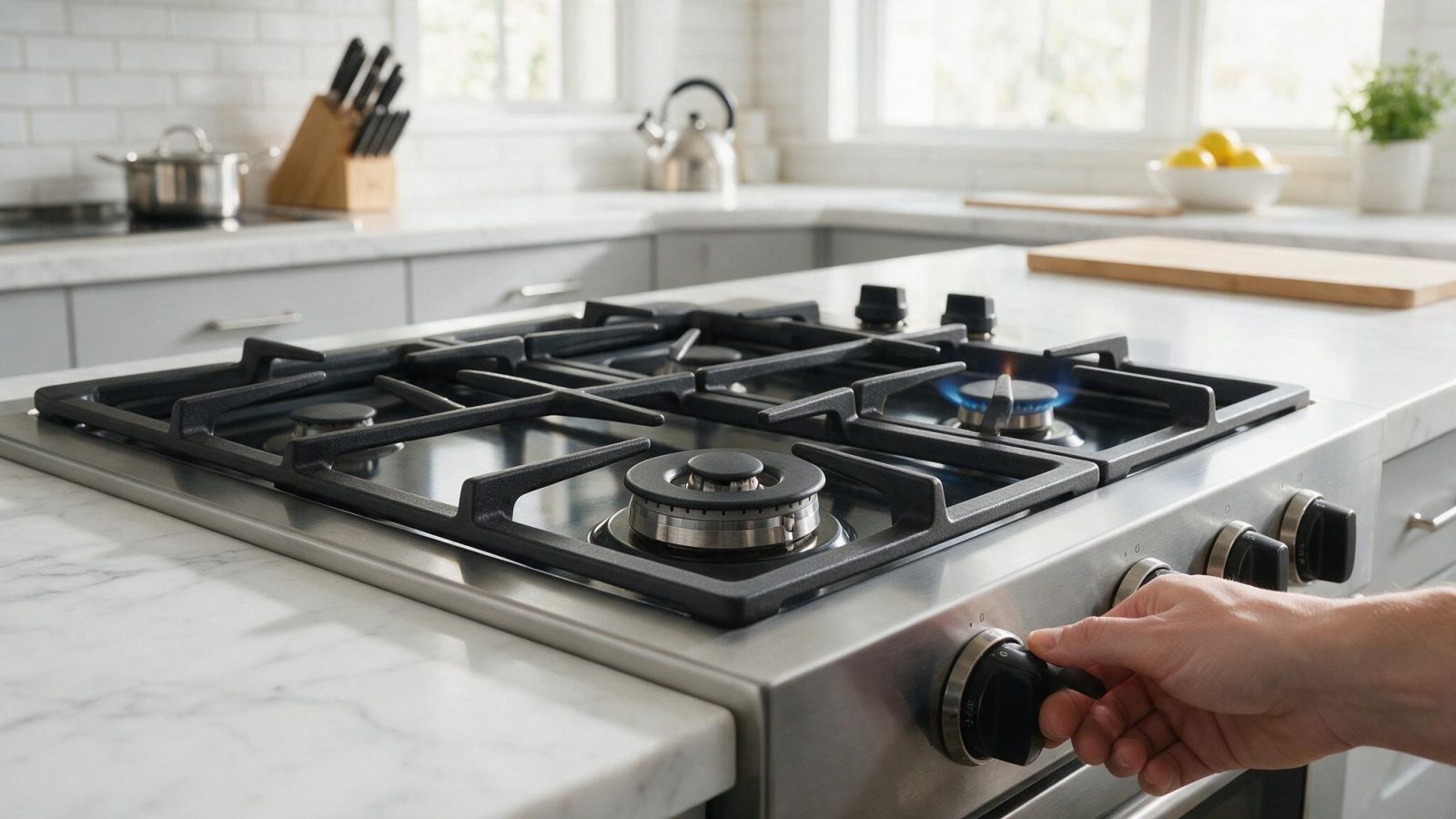
A Bosch gas burner that clicks but will not light may have moisture, residue, cap-position, ignition, or gas-supply conditions. Keep checks external.
When a Bosch gas burner clicks but will not light, the most useful first checks are the ones you can see from the outside: whether the cap is seated correctly, whether the burner and igniter area are dry and clean, and whether the cooktop has power. Clicking only shows that the system is trying to spark; it does not show that gas is arriving. If you smell gas, or the burner still will not light after those checks, stop and book service.
Clicking tells you the ignition system is attempting to create a spark. It does not tell you whether gas is arriving correctly or whether the burner is assembled and dry enough to light normally.
Do not continue repeated ignition attempts.
Follow the appropriate gas-safety procedure and avoid creating another flame or spark.
The click is the igniter sparking. A spark with no flame can come from a wet or dirty igniter, a cap or base that is out of position, residue in the burner ports, or something upstream of the burner. The cooktop is also not always as quiet as you expect: the use-and-care manual for one NGM-series model says igniters can spark once or twice after first power-up or after power is restored, even with every knob off. A brief round of clicks after an outage is not by itself a fault.
Moisture around the burner and ignition area can affect lighting.
With the cooktop cool and power/gas controls in the normal off position, allow removable parts to dry.
The manual for one Bosch gas cooktop describes a damp, damaged, or dirty igniter as something that will prevent a burner from lighting. It suggests cleaning the igniter gently with a damp cotton swab or a toothpick, avoiding excess water. Do that only with the cooktop cool and every control off.
| What you see | What it can point to | What you can safely check |
|---|---|---|
| Clicking continues on all burners after the cooktop was plugged in | The manual for one model lists incorrect house wiring, a misaligned cap or base, or a wet or dirty igniter | Dry the burner area and check the cap seating; leave wiring to an electrician |
| Clicks but one burner does not light | A cap out of position, residue, or a damp or dirty igniter at that burner | Cool the cooktop, dry the parts, and reseat the cap on its matching base |
| No click and no light on any burner | A power condition such as the unit being unplugged or a tripped breaker | Confirm the cooktop has power and the breaker has not tripped |
| Lights, then goes out | A condition beyond cap position and moisture | Note which burners do it and stop trying repeatedly |
| Clicking together with a gas odor | A gas-safety situation | Stop all ignition attempts and follow your gas-safety procedure |
If your model uses a removable cap, make sure it is seated in its normal position.
Do not file, drill, or enlarge burner openings.
The same manual says caps and bases are matched by size letter, so a cap sitting on the wrong base can also interfere with lighting. If a burner has just been cleaned, confirm each cap went back where it came from.
If one burner fails while others operate normally, record that difference.
If all burners are affected after a gas-supply interruption, the diagnostic context is different.
The manual for one NGM-series cooktop lists a short group of checks for a burner that does not light: the gas shut-off valve for the cooktop, the cap positions, the ports, clean and dry igniters, and the unit being plugged in with its breaker not tripped. The power items are plain to check from outside. For the gas valve, look at whether the handle is in the normal on position and, if plumbing or gas work was just done, leave any reopening and leak testing to the person who did it.
Burner ports are another item on that list, but this article’s earlier warning stands: do not file, drill, or enlarge the openings. Follow the manual for your own model for any port cleaning, and stop if you are unsure.
Does the burner click continuously? Does it light and then go out? Does the spark appear only intermittently?
Those details help a technician separate external burner conditions from ignition, valve, wiring, or control faults.
A single burner that fails while the others light usually keeps the question local to that burner: its cap, base, ports, and igniter. If all burners fail together, think about what they share, such as power to the cooktop or a gas-supply interruption. Keep those two situations apart when you describe the problem, because they send the diagnosis in different directions.
Do not:
Use Bosch Cooktop Repair and Safe Bosch Troubleshooting: What You Can Check Without Opening the Appliance if the burner still will not light.
It means the system is attempting ignition; the complete spark/gas condition still needs evaluation.
Residue or moisture can cause a no-light condition, but not every ignition fault is a cleaning problem.
Only if the use-and-care manual for your cooktop describes lighting a burner by hand, and never when you smell gas. Otherwise leave the burner off and book service.
A wet igniter or a cap that was put back off-center are the first things to recheck. The manual for one model lists a misaligned cap or base and a wet or dirty igniter among the causes of continued clicking.
The manuals read for this article do not give a drying time, so judge by whether the cap and igniter area are visibly dry, and follow your own manual.
Not if there is a gas odor. Without an odor, one more attempt once everything is visibly dry is reasonable, but repeated clicking with no flame is a reason to stop and call.
A Bosch error code is most useful when you save the exact display, appliance type, model, cycle stage, and symptoms before resetting.
A Bosch induction zone that does not detect cookware should be tested with a known-compatible pan before power electronics are blamed.
A Bosch oven cycles around its setpoint, so one thermometer reading can be misleading. Compare a stable pattern before adjusting calibration.
Share a few details and we’ll confirm an appointment. Prefer to talk? Call us and we’ll help right away.
Use the secure scheduler below to request your appointment.