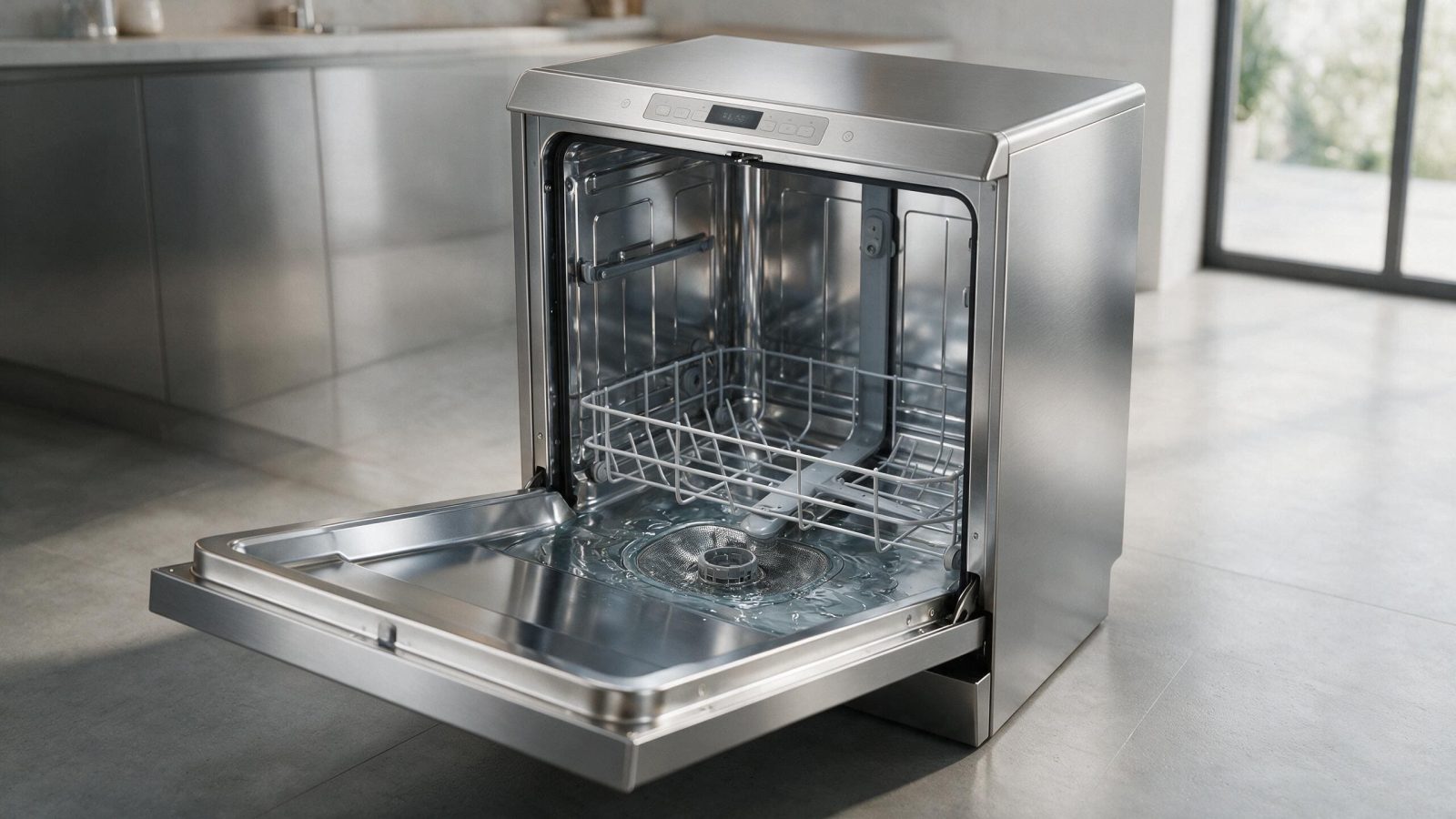
Bosch dishwasher not draining? Start with the filter, accessible pump area, drain hose, and sink connection before internal diagnosis.
When a Bosch dishwasher leaves water in the tub, the cause is not always the drain pump. Clean the filter your manual identifies, look for a kinked drain hose, and think about the sink-side connection such as a garbage disposal. If water remains after the accessible path is clear or a drain code returns, the pump or installation needs diagnosis.
Standing water after the program is a drainage symptom. It does not automatically prove the drain pump failed.
The most useful approach is to follow the water path from the user-accessible dishwasher area toward the household drain.
| Symptom | What it can point to | What you can safely check |
|---|---|---|
| Water above the expected sump area after the cycle | Blocked filter or restriction in the drain path | Clean the filter your manual identifies and look at the visible drain hose |
| Standing water after sink or disposal work | A sink-side connection issue | Check the disposal connection and the air gap if there is one |
| Display shows E24 or another drain code | A drain-related condition for your platform | Read the code entry for your model and follow its steps |
| Pump hums but water does not leave | A blockage or a pump condition | Switch off and stop forcing cycles; this is useful evidence for service |
| Water is gone but the tub smells | Residue left in the filter or rim | Clean the filter and rim and see whether smell fades |
If the dishwasher displays E24 or another drain-related warning, photograph it before resetting.
The exact code and model/E-Nr help separate different Bosch dishwasher platforms. Use Bosch Dishwasher Error Codes for the matching code page.
After the wash, the drain pump sends water through the drain hose toward the household drain, through a sink-side connection such as a garbage disposal or an air gap. A restriction at any point between the tub and that drain can leave water behind, which is why the symptom does not by itself point to the pump.
The use-and-care manual for one Bosch dishwasher describes E:61-03 (not draining) and E:61-02 as not appliance errors. It lists a garbage disposal plug, a kinked drain hose, the drain pump cover, and a missing high loop as the places to look. Manuals differ by model and platform, so confirm which entries apply to yours.
Before handling a user-removable filter or accessible pump-cover area, turn the dishwasher off as described in the owner documentation.
Remove and clean only the filter your manual identifies as user-serviceable.
Food debris can restrict drainage and also affect wash quality and odor.
Some Bosch models allow a limited user check around the pump cover. Follow the exact manual because sharp debris can be present.
Never reach into the area with power connected.
The same manual describes cleaning the drain pump area on that model, and it warns that sharp debris such as glass may be present. It also tells you to unplug the dishwasher and remove racks and the filter first. That warning is the reason this article keeps the pump area at a limited, manual-guided check.
Look for an obvious kink in the drain hose.
If the dishwasher connects through an air gap or disposal, check for an external blockage and note any recent sink/disposal work.
A filter that is clean and seated removes one possible blockage point. If water still stays, the evidence points past the filter: a hose, the sink connection, or an internal part. E:92-40 on one Bosch manual means the filters are soiled or blocked, so it reads as a different condition from a drain code, even though both can leave a wet tub.
If the dishwasher was working before a new disposal or sink was installed, say so when you ask for service. A disposal plug that was never cleared or an installation detail can look like a pump fault but sits outside the dishwasher.
Do not:
If the accessible path is clear but the machine still leaves water, the internal drain pump, sensing, wiring, or installation may need diagnosis.
A pump that hums without moving water is useful evidence; it is not a reason to keep forcing it.
Use Bosch Dishwasher Repair if the drain warning returns.
No. Bosch associates E24 with drainage, and several restrictions or components can create that condition.
The sink-side connection can affect dishwasher drainage, especially after plumbing changes.
A small amount in specific sump areas can be normal; standing water above the expected area after the cycle is different.
The manual for one Bosch model lists a missing high loop among the installation causes of drainage problems. It is part of how the hose is routed under the sink, so check your installation instructions for how yours should be set up.
Yes. One Bosch manual lists a garbage disposal plug among the causes for E:61-03. If the dishwasher was installed or the disposal replaced recently, that connection is worth checking.
It can leave water behind, but a different manual entry describes filters as soiled or blocked. If cleaning the filter does not clear the standing water, move to the drain path.
A Bosch error code is most useful when you save the exact display, appliance type, model, cycle stage, and symptoms before resetting.
A Bosch induction zone that does not detect cookware should be tested with a known-compatible pan before power electronics are blamed.
A Bosch oven cycles around its setpoint, so one thermometer reading can be misleading. Compare a stable pattern before adjusting calibration.
Share a few details and we’ll confirm an appointment. Prefer to talk? Call us and we’ll help right away.
Use the secure scheduler below to request your appointment.