A Bosch refrigerator that runs but stays too warm needs a measured cooling check. what to record safely before service.
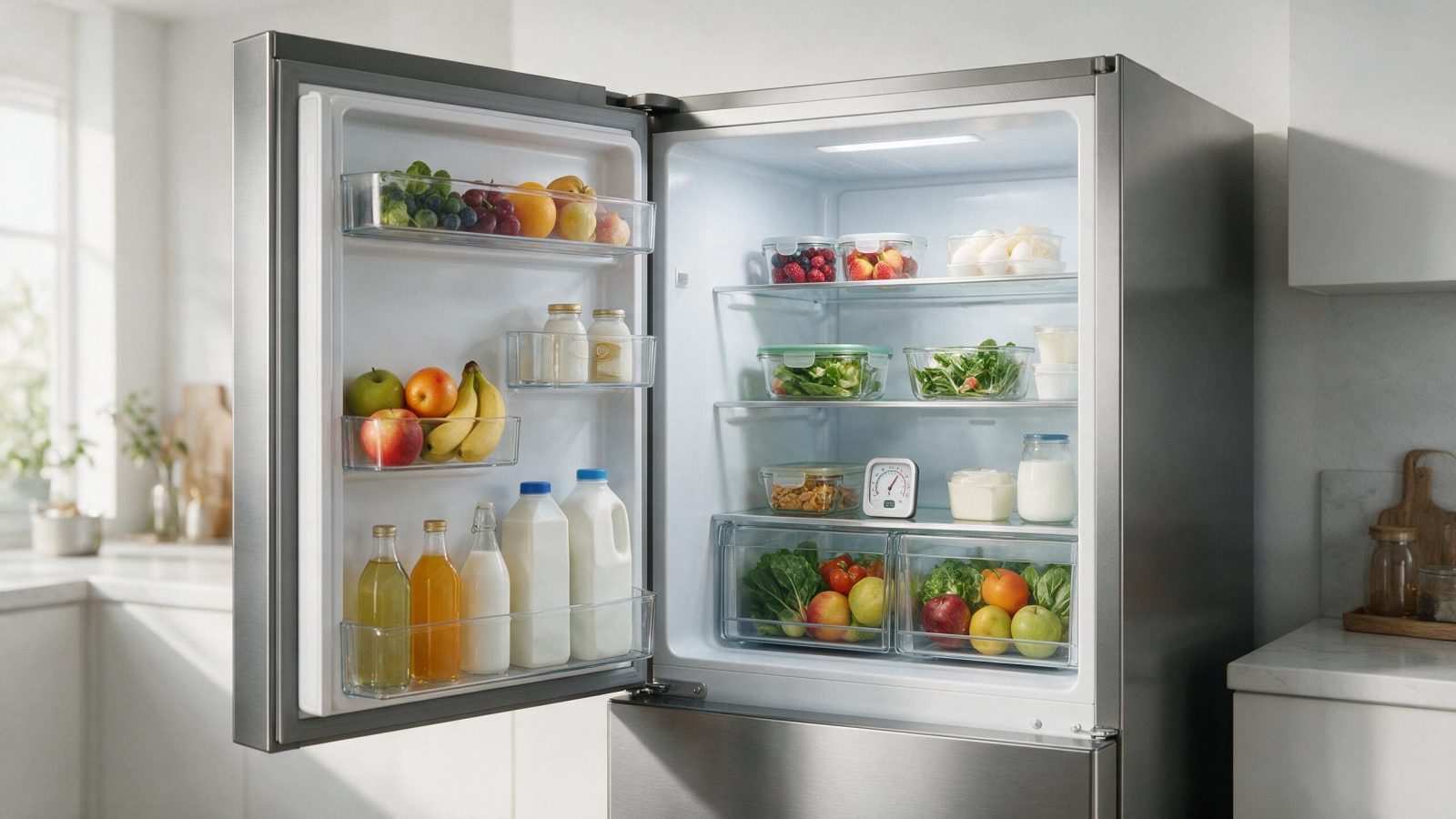
A Bosch refrigerator that runs but feels warm may have a cooling fault, but settings, loading, door closure, and recovery after a power loss can also be the reason. Measure each compartment, check the setting and any special mode, and make sure the door seals. If the temperature stays out of range after the cabinet stabilizes, book diagnosis.
A refrigerator can sound completely normal and still fail to hold the temperature you expect. The most useful first question is not “Which part is bad?” but “Which compartment is warm, by how much, and under what conditions?”
| Symptom | What it can point to | What you can safely check |
|---|---|---|
| Both compartments warm after a power interruption | Recovery period or a setting needing readjustment | Check the setting and allow time to stabilize |
| Fridge warm, freezer normal | A problem affecting one compartment | Measure both and avoid changing several settings at once |
| Warm after a large grocery load | Temporary load effect | Recheck once the cabinet has had time to recover |
| Door alarm or temperature alarm showing | An open door or a cabinet that is too warm | Close the door and read the display |
| Warm at the set temperature of an Eco or vacation mode | A special mode that raises the setting | Check whether such a mode is switched on |
Use a reliable refrigerator thermometer and give the cabinet time to stabilize with the doors closed. If the fresh-food section is warm but the freezer remains normal, record that difference. If both sections are warming together, record that too.
Avoid changing several settings at once. When temperature, loading, and control settings all change together, you lose the ability to tell which condition actually mattered.
The manual for one Bosch refrigerator lists factory settings of 39 F for the refrigerator and 0 F for the freezer. The refrigerator adjusts from 34 F to 44 F and the freezer from 9 F to -8 F, and the manual says to allow several hours before loading food after a change.
That same manual describes Super Cool, which sets 34 F and ends automatically, Super Freeze, which sets -8 F for up to 6 hours, and Eco Mode, which sets 44 F and 5 F for vacations. A refrigerator in Eco Mode will read warmer than the default, and that is the setting doing its job. Check whether your model has such a mode before assuming a fault.
Without removing panels, make sure packages are not pressed against visible air outlets and that the doors close fully. A container that prevents a door from sealing can create a real temperature problem without any internal component failure.
Look at the gasket for obvious debris or a section that is folded out of position. Do not use a heat gun or aggressive “gasket reshaping” trick.
The Bosch US refrigerator FAQ gives a recommended range for each compartment, and comparing a thermometer reading with it is a better test than touch.
Cooling can temporarily look weak after:
The useful clue is whether the refrigerator recovers and stabilizes.
The manual for one Bosch refrigerator says that after a power failure the fresh food compartment temperature must be readjusted. If the setting did not return to where you expected, the cabinet may be recovering to a different target than before.
The same manual describes a door alarm that sounds after the door has been open more than one minute and repeats every 60 seconds for 5 minutes, and a temperature alarm when the cabinet gets too warm. Either one is a direct clue, because a door that is not closing or a cabinet that is too warm is exactly what the alarm exists to report.
Arrange diagnosis when measured temperature remains outside the expected range, the problem repeatedly returns, one compartment behaves very differently from the other, frost develops rapidly, or a new fan/compressor sound appears with the temperature change.
Internal fan testing, compressor diagnosis, refrigerant work, and live electrical testing are not homeowner checks.
For model-specific context, use the Bosch Refrigerator Models directory and the Bosch Refrigerator Error Codes reference if the display shows a code.
If the refrigerator does not recover after the safe checks, request Bosch Refrigerator Repair and include the measured temperature pattern rather than only “not cooling.”
No. Airflow, door sealing, sensors, fans, defrost operation, controls, and the refrigeration system can all affect temperature.
Not for an ordinary cooling complaint unless there is an electrical or water hazard. The operating pattern can help diagnosis.
The full model/E-Nr, measured temperatures, which compartment is affected, any displayed code, and your ZIP code.
Yes. The manual for one Bosch model says Eco Mode sets 44 F and 5 F for vacations. If that mode is on, a warmer reading is expected until you switch it off.
One Bosch manual says Super Cool sets 34 F and ends automatically. It is meant for short use, so compare the cabinet afterward.
A Bosch manual says to allow several hours before loading food after a change. Measure again once the cabinet has had that time, and change only one setting at a time.
A changed Bosch gas flame can involve burner cleanliness, cap position, moisture, or a gas/combustion condition. Use only safe external checks.
Uneven Bosch oven baking can involve rack position, pan material, airflow, heating, sensing, or control. Build a repeatable comparison first.
A Bosch dryer that needs two cycles can have airflow, load, program, heating, sensing, or condensation problems. Identify the dryer type first.
Share a few details and we’ll confirm an appointment. Prefer to talk? Call us and we’ll help right away.
Use the secure scheduler below to request your appointment.