New Bosch refrigerator noise is easier to diagnose when you record when it starts, what changes it, and whether cooling is affected.
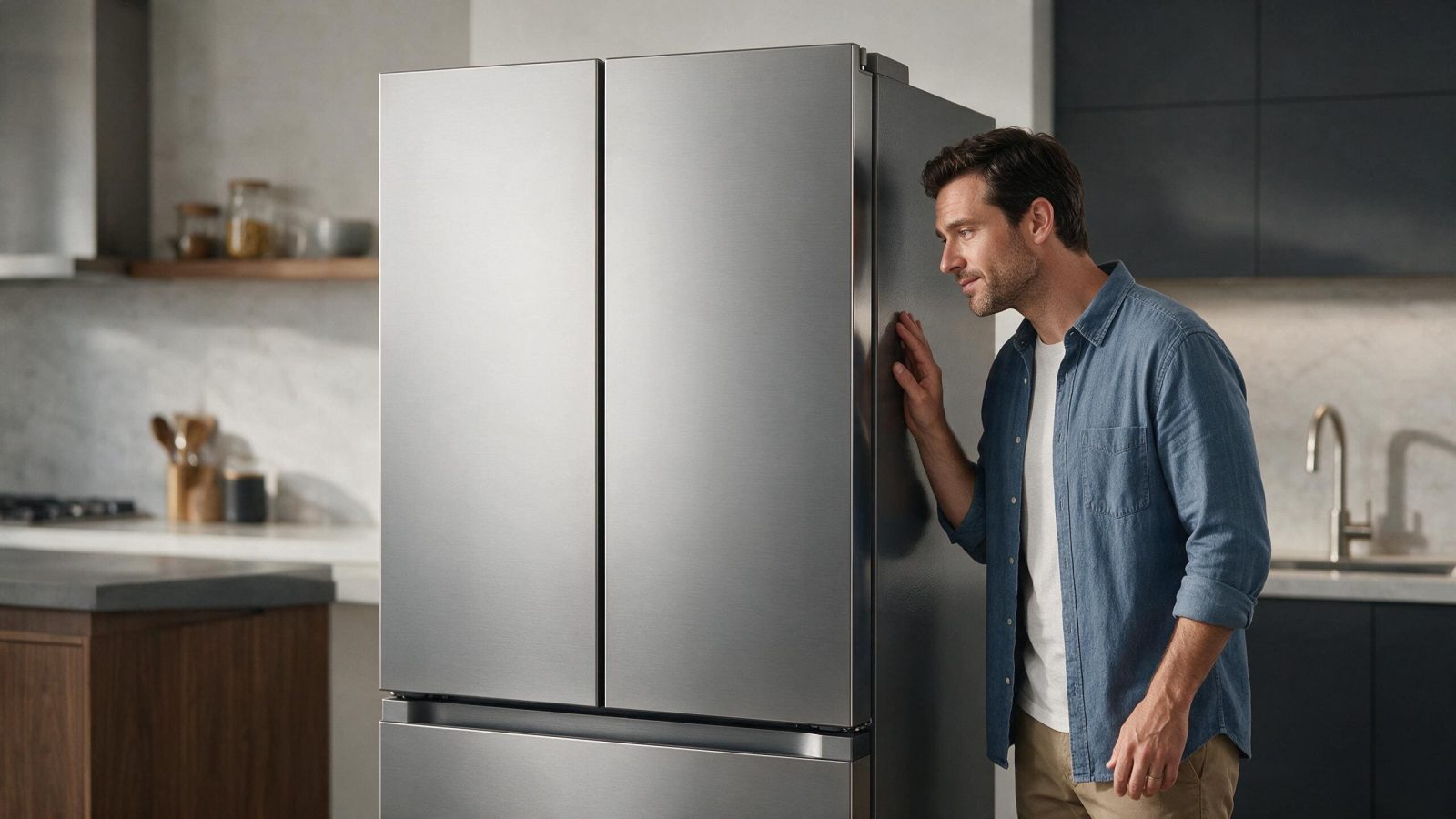
A new noise from a Bosch refrigerator is easier to understand when you tie it to timing: after the door closes, during ice production, or when the compressor starts. Remove simple vibration sources first, check the actual temperature, and book service if the sound is a scrape or grind, repeats in a start-click-stop pattern, or comes with a rising temperature.
Refrigerators normally make more than one sound. Fans start and stop, refrigerant moves, the compressor changes operating state, and ice systems can produce short mechanical noises. A new sound becomes useful diagnostic evidence when you connect it to timing and performance.
| Symptom | What it can point to | What you can safely check |
|---|---|---|
| Beeping at intervals | A door or temperature alarm | Check that the door is fully closed and look at the temperature reading |
| Motor-like sound some time after the unit is filled or restarted | The ice maker water valve | See whether ice and water behave normally afterward |
| Rattle when the compressor runs | Items touching or a vibrating shelf | Separate bottles and move items on top of or beside the unit |
| Scrape or harsh grinding | A moving part contacting something | Leave the cabinet closed and book service, especially if temperature rises |
| Repeated click, start, stop | A condition that needs diagnosis | Check the temperature and stop trying resets |
Instead of “it is loud,” note whether the sound is:
Then record when it occurs. Does it start after a door closes? During ice production? When the compressor begins a cooling cycle? Does opening a refrigerator or freezer door change it?
Some new sounds are built-in signals. The manual for one Bosch refrigerator says the door alarm sounds after the door has been open for more than one minute and repeats every 60 seconds for 5 minutes, and that a temperature alarm appears when the cabinet gets too warm. A beeping refrigerator may therefore be asking for the door to be closed or for attention to the temperature.
The same manual says that on a model with an ice maker, a motor sound after about two hours is the water valve. A sound from the valve is part of making ice and does not by itself point to a failing part. If you hear it when ice production starts, compare the sound with how ice and water actually behave.
Check bottles, bins, shelves, and objects on top of or beside the refrigerator. Two glass containers touching can amplify a small vibration into a surprisingly loud rattle. Glass bottles standing against each other or against the wall of the compartment are a frequent cause of this kind of rattle, and a few seconds spent separating them costs nothing.
Make sure the cabinet is not physically contacting nearby furniture in a way that transfers vibration.
A shelf, drawer, or bin that is not seated can also vibrate against the cabinet when a fan or compressor runs. Pressing each one back into position is a quick check that does not involve any panel.
Do not remove rear covers to “find the fan” while the appliance is powered.
Noise without a performance change can have a different priority than noise plus a warming compartment.
Take an actual temperature reading. If the refrigerator is cooling normally and the sound is brief and repeatable, the information is still worth recording. If temperature is rising or the sound is a scrape, repeated start-click-stop pattern, or harsh mechanical grind, service becomes more urgent.
If shifting items stops the sound, you have found a vibration source rather than a fault. If the sound stays, nothing about it names a part. The article above says several components can create similar sounds, which is why a description of timing and the temperature reading matter more than a guess.
A sound that appears together with a warmer cabinet is more significant than a sound alone. A sound that appears only briefly during ice production is a different pattern again. Each narrows what a technician needs to test.
Leave the refrigerator off if the new sound is accompanied by electrical odor, sparking, repeated breaker trips, or visible overheating.
A technician can compare the sound with fan operation, compressor/inverter behavior, ice mechanisms, and model-specific components.
Use Bosch Refrigerator Repair for service and the Bosch Models directory to confirm the full model before diagnosis.
A short video or audio clip, the full model/E-Nr, and a note about when the sound occurs are more useful than trying several resets.
A recording can help, but it is not a complete diagnosis. Several components can create similar sounds.
Not necessarily. Record the sequence and whether cooling changes.
Not if it becomes harsh, continuous, or appears with rising temperature.
The manual for one Bosch model describes a door alarm after the door has been open for more than one minute and a temperature alarm when the cabinet gets too warm. Closing the door fully and checking the temperature are the first steps.
One Bosch manual attributes a motor sound a couple of hours after filling to the water valve. A brief sound tied to ice production is different from a scrape or grind.
It can, when the sound comes from containers or shelves touching. If the sound remains after you separate everything, treat it as a pattern to describe to service.
A changed Bosch gas flame can involve burner cleanliness, cap position, moisture, or a gas/combustion condition. Use only safe external checks.
Uneven Bosch oven baking can involve rack position, pan material, airflow, heating, sensing, or control. Build a repeatable comparison first.
A Bosch dryer that needs two cycles can have airflow, load, program, heating, sensing, or condensation problems. Identify the dryer type first.
Share a few details and we’ll confirm an appointment. Prefer to talk? Call us and we’ll help right away.
Use the secure scheduler below to request your appointment.