A Bosch washer leak is easier to diagnose when you record its location and cycle timing before moving or opening the appliance.
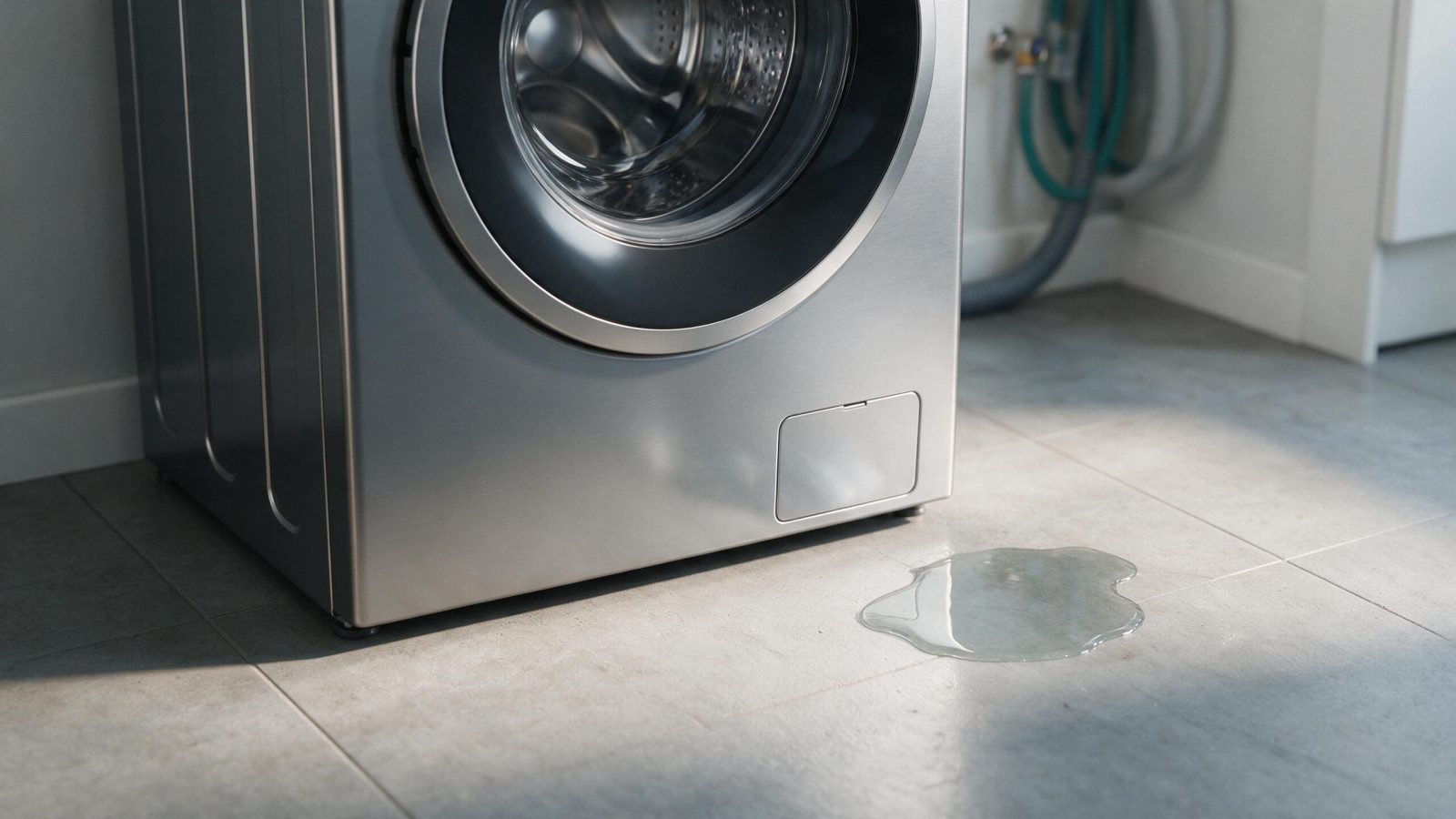
With a leaking Bosch washer, where the water first appears and what the washer was doing at the time tell you more than the size of the puddle. Look from the outside, match the leak to the cycle stage, and check whether heavy suds are involved before anything is moved. Stop using the washer if water keeps appearing, a water-protection code shows, or water gets near electrical connections.
The size of a washer puddle is less useful than where the water begins and when it appears.
Do not move the washer immediately. Movement can smear the leak path and can damage hoses, flooring, or cabinetry.
Check whether water is visible:
If water approaches an outlet or electrical connection, stop and disconnect power only if it can be done safely.
| Where water appears | What it can point to | What you can safely check |
|---|---|---|
| Around the door during tumbling | Seal contact area dirty or loading pressing on the seal | Look at the visible seal and its contact area; the Bosch US leak page names a dirty door seal contact area as one cause |
| Below the detergent dispenser, with suds | Too much or old detergent, or non-HE detergent | Check the detergent type and amount against the manual |
| At the visible supply hose | A loose or worn external connection | Look without tightening anything inside the washer |
| Near the external drain hose | The external drain path | Look at the hose position and visible connections |
| Under the center of the machine | An internal water path | Stop the cycle and book service |
| Hose-activation code appears | The manual for one model says E23/F23 means the AquaStop hose has activated | Do not use the washer and turn off the water tap right away |
The manual for one Bosch front-load washer says to use only HE detergent. Too much detergent, or detergent that is not HE, causes suds, slow draining, foam out of the dispenser drawer, and an E:18 message, and it also says too little can leave laundry gray. Foam can look like a leak because it pushes soapy water out of the drawer and around the door.
The Bosch US leak page names old or excess detergent from the drawer among the causes of leaks. If the water is soapy and appears below the drawer, check the detergent before suspecting a hose.
Too much or unsuitable detergent can create foam that moves water toward areas that normally stay dry.
Record heavy suds if present.
The Bosch US support page on seal care says to wipe the seal with a soft damp cloth and to avoid abrasive and chlorine cleaners, which can degrade the rubber. It also says that where the water pools is a clue. A dirty contact area between the door and the seal is listed as one cause of leaks at the door, so cleaning the visible area gently is worth doing before assuming the seal has failed.
A short observation is enough. Running full loads repeatedly can create floor or cabinet damage.
Stability can play a part in leaks that show up only during spin. The manual for one Bosch washer says all four feet must press equally on the floor, nothing should be placed under the feet to level it, and all four transport bolts must have been removed before use or the washer will vibrate and the drum can be damaged. A washer that shakes hard can stress hoses and connections, so a leak that appears only at high speed may be linked to how the machine is standing.
Use Bosch Washer Error Codes if a leak-protection or water code appears.
The Bosch US error page says that E23/F23 means the AquaStop hose has been activated. It says not to use the washer and to turn off the water tap right away. That is a protection response, not something to clear. If the code appears together with water on the floor, treat the tap and the power as the first steps, then book service with the code and the cycle stage.
Clear the area around the washer and mop only if it is safe to do so; do not put your hands near wet outlets.
Request Bosch Washer Repair with the leak location and cycle stage.
Not automatically. Debris, loading, alignment, foam, and other conditions can contribute.
Internal service access is not a homeowner leak check.
Not unless access can be done safely and without stressing connections.
Yes. The manual for one Bosch washer says too much or non-HE detergent causes suds and foam from the drawer, which can spill water into places that are normally dry.
Not necessarily. The Bosch US leak page lists a dirty door seal contact area and old or excess detergent among the causes, so check those first.
The Bosch US error page says E23/F23 means the AquaStop hose has been activated, and that you should not use the washer and should turn off the water tap right away.
A changed Bosch gas flame can involve burner cleanliness, cap position, moisture, or a gas/combustion condition. Use only safe external checks.
Uneven Bosch oven baking can involve rack position, pan material, airflow, heating, sensing, or control. Build a repeatable comparison first.
A Bosch dryer that needs two cycles can have airflow, load, program, heating, sensing, or condensation problems. Identify the dryer type first.
Share a few details and we’ll confirm an appointment. Prefer to talk? Call us and we’ll help right away.
Use the secure scheduler below to request your appointment.