A Bosch dishwasher leak is easier to diagnose when you record where the water appears and which cycle stage produces it.
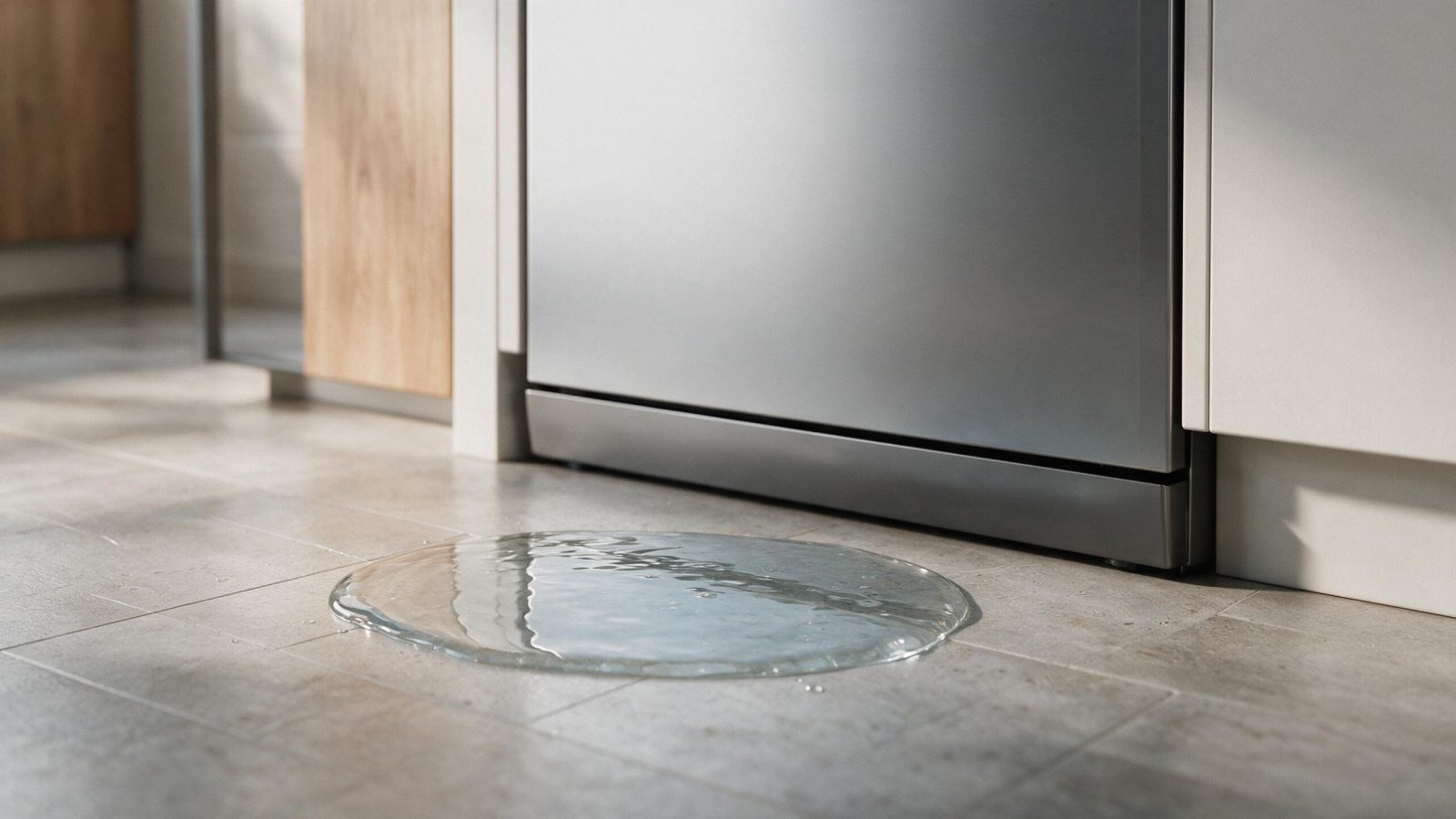
Water around a Bosch dishwasher is best narrowed by timing and location: where the water appears, and whether it showed up while filling, during the wash, during draining, or after the cycle. If the leak is active, stop the dishwasher and shut off the water supply when that is safe. A water-protection code is a stop condition, not something to reset and carry on using.
A puddle tells you that water escaped. The timing tells you much more.
Water near the front during filling can come from a different path than water appearing underneath during circulation or near the end of drain.
If the leak is active, stop the dishwasher and shut off the water supply when it can be done safely.
The manual for one Bosch dishwasher uses the display term water protection system for E:30-00 and E:31-00, and says to close the water supply valve and contact customer service when either appears. It lists E:34-00 as water that keeps running in. An older Bosch manual describes AquaStop as a tub and sensor system with a molded base that contains leaks, shuts the dishwasher down and pumps water out, and can turn itself on, working around the clock.
Because the protection can act on its own, a dishwasher that restarts or pumps while you are not using it may be responding to water in the base. Treat that as a leak, not a glitch. Codes differ by model, so use the manual for yours.
From a safe external position, note whether water appears:
Do not pull an integrated dishwasher out of the cabinet simply to inspect underneath.
Did the leak appear:
That timing can help a technician choose the first inspection path.
| Where and when | What it can point to | What you can safely check |
|---|---|---|
| Front edge during wash | Door area, loading, or foam | Look at how items are loaded and whether suds are heavy |
| Front, only after a cycle ends | Condensation or water trapped on the door or tub | Compare with a wet tub, which the manual for one model says is not an error |
| Under the center during draining | The drain path | Check external drain hose and sink connection visually |
| Near the supply side while filling | A supply connection | Look at visible supply connections and recent plumbing work |
| E:30-00 or E:31-00 on the display | The manual for one model calls this the water protection system | Close the supply valve and stop using the dishwasher |
| Drain code E:61-03 | The manual for one model says this is not an appliance error: a garbage disposal plug, a kinked drain hose, a drain pump cover, or a missing high loop | Check the disposal plug and hose before booking |
The manual for one Bosch dishwasher says a wet tub after the cycle is not an error. It explains that condensation drying leaves droplets on the tub walls that run off and are pumped out, and Bosch US support says all of its dishwashers use condensation drying. Moisture on the door or tub after a cycle is therefore different from water pooling on the floor, and the floor is what matters here.
If the dishwasher displays E15 or another water-protection warning, photograph the code.
Do not tilt the machine to empty the base so the code disappears. A cleared display does not fix the water source.
Use Bosch Dishwasher Error Codes for the exact warning.
Drain codes are a separate family. The same manual lists E:61-03 and E:61-02 as not appliance errors and points to a garbage disposal plug, a kinked drain hose, the drain pump cover, or a missing high loop. A filter-related code, E:92-40, means the filters are soiled or blocked. These are worth reading before assuming a leak inside the machine.
Check only what is safely visible:
Internal hoses, pumps, seals, valves, and electrical components need service access.
The filter sits at the bottom of the tub, and Bosch US support says it needs regular cleaning to avoid overflow. A blocked filter keeps water from draining, and standing water can find the front edge. Excess foam from the wrong detergent or too much of it can do the same and is on the safe-to-check list above.
A short run is enough to see whether the problem repeats. Running full cycles to reproduce a leak risks floor and cabinet damage.
Request Bosch Dishwasher Repair with the model/E-Nr, leak location, cycle stage, and code.
No. Loading, foam, spray behavior, alignment, and other water paths can create front-area leaks.
A leak-protection warning should not be treated as a reset-only condition.
Leave built-in removal to a planned service process.
No. The manual for one Bosch dishwasher says condensation drying leaves droplets on the tub walls that run off and are pumped out, and that a wet tub is not an error.
Bosch US support says the filter needs regular cleaning to avoid overflow, so a blocked filter can cause drainage trouble that shows up as water near the front.
The manual for one model says to close the water supply valve and contact customer service. Do not reset it and keep running the cycle.
A changed Bosch gas flame can involve burner cleanliness, cap position, moisture, or a gas/combustion condition. Use only safe external checks.
Uneven Bosch oven baking can involve rack position, pan material, airflow, heating, sensing, or control. Build a repeatable comparison first.
A Bosch dryer that needs two cycles can have airflow, load, program, heating, sensing, or condensation problems. Identify the dryer type first.
Share a few details and we’ll confirm an appointment. Prefer to talk? Call us and we’ll help right away.
Use the secure scheduler below to request your appointment.