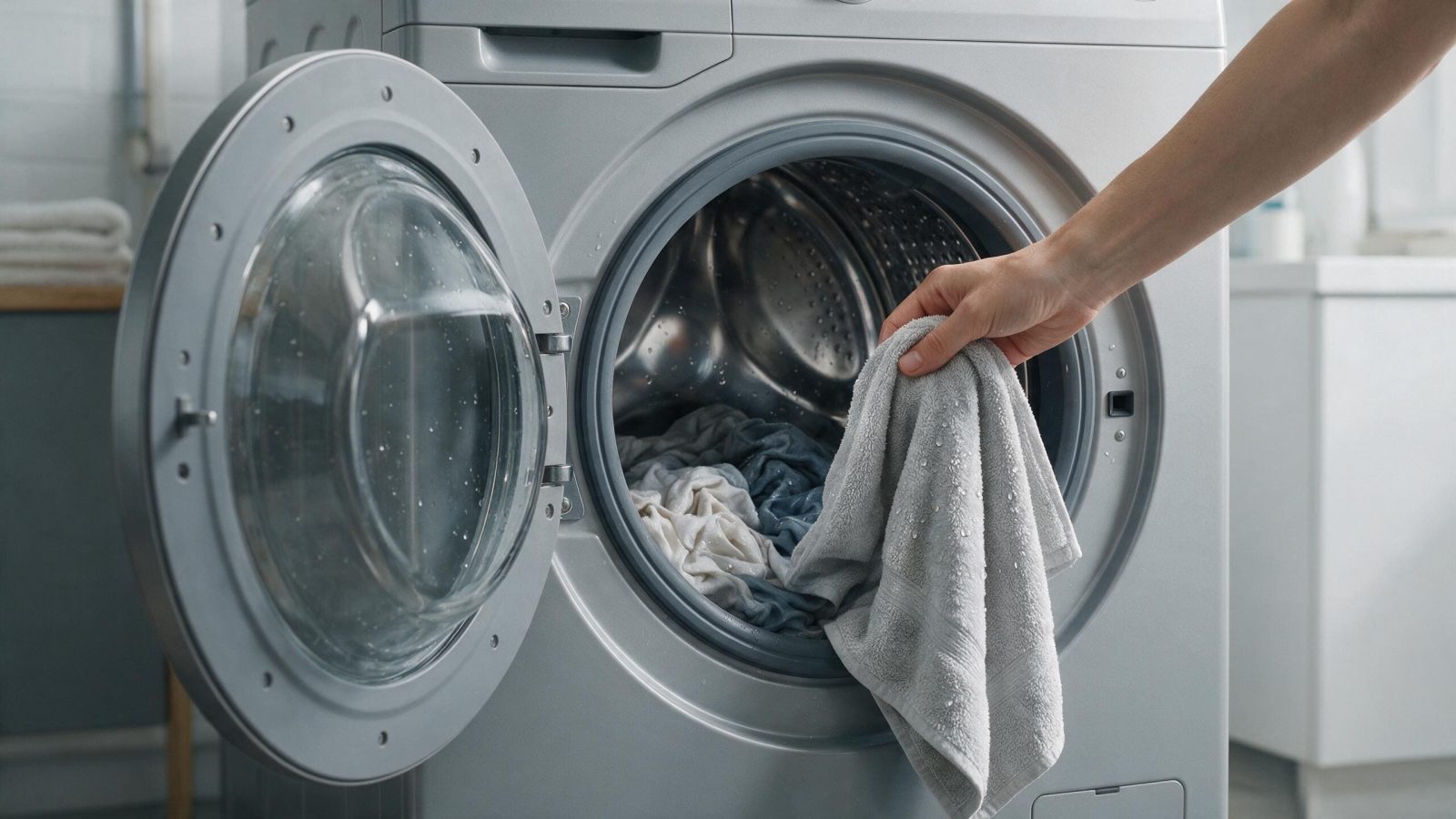
A Bosch washer that leaves clothes wet may have a drainage or balance condition before it has a motor problem. Record the cycle stage first.
When a Bosch washer finishes with wet clothes, check whether water is still in the drum first, because drainage comes before spin. If the drum is empty, the next question is load balance, then stability and installation, and only then drive or control systems. A washer that shakes violently should be stopped rather than pushed through another spin.
Wet clothes at the end of a cycle are often described as “the washer will not spin.” But high-speed spin is only one part of the process. The washer also needs to remove water and manage the load safely.
Look through the door. If water is still in the drum, drainage becomes the first question.
Listen for whether the pump attempts to run. A pump sound without normal water removal is useful evidence.
Use only the owner-manual drain/filter procedure for the exact model because residual water may be hot.
The manual for one Bosch washer describes cleaning the drain pump when the washer fails to drain, and says up to 5.3 gallons of water may come out when the service cover is opened and that the impeller must turn freely. It also advises checking the drum for debris after each load. Follow the manual for your model, since pump access differs.
| What you notice | What it can point to | What you can safely check |
|---|---|---|
| Water still in the drum at the end | A drainage condition that also blocks spin | Use the manual’s drain and filter procedure for your model |
| Pump runs but water does not leave | A blocked drain path or pump | Share the sound with a technician; do not open the machine |
| Spin starts, then slows and retries | Unbalanced-load detection reducing speed | Mix large and small items and rerun one balanced cycle |
| Heavy suds and slow drain | Too much or non-HE detergent, according to the manual for one model | Check the detergent type and amount |
| Loud shaking in spin on a new installation | Transport bolts not removed or feet not level | Compare with the manual’s installation notes |
| Code on the display | A drainage, imbalance, door, or drive condition | Match the code to the washer table |
A single heavy item or a very small load can be difficult to distribute.
If the washer repeatedly tries to accelerate and slows down again, redistribute the load and compare one normal balanced cycle.
The manual for one Bosch washer says automatic unbalanced-load detection spins the load several times, and if the load is unevenly distributed, spin speed is reduced or no spin happens. Mixing large and small items is its advice. That means a wet result can be the machine protecting itself, and one balanced cycle is a sensible test.
Do not keep forcing high-speed spin if the machine is moving violently.
A bath mat or comforter washed alone is a typical case: one bulky item can bunch up on one side and keep the washer from reaching full speed. Adding a few smaller items to even out the load is the manual’s approach.
It is also worth separating a wet load from a washer that never started spinning. If you can hear the drum accelerate and then ease off, the balance logic is working. If there is no spin attempt at all, record that for the technician.
Bosch washer codes can distinguish drainage, imbalance, door, drive, water, and other conditions.
Photograph the code before resetting and use Bosch Washer Error Codes.
If the washer was recently moved or installed, check that it is stable and level.
A machine that suddenly became much louder after years of normal use deserves different attention than a new installation that has never been stable.
The same manual says all four transport bolts must be removed before use or the washer will vibrate, be noisy in spin, and the drum can be damaged. It also says all four feet must press equally on the floor, that nothing should be placed under the feet to level it, and that they should be extended no more than necessary. A washer that shakes hard may be cutting its spin short, which leaves clothes wetter.
If the washer has run for years and became noisy recently, that points to a different set of questions than a new installation that has never been stable.
If drainage is normal, the load is balanced, and the washer still cannot reach expected spin, diagnosis may move toward the drive, speed feedback, sensing, suspension, or control systems.
The manual for one Bosch washer says too much or non-HE detergent causes suds, slow draining, and foam out of the drawer, and lists an E:18 message with it. Heavy suds can keep the washer from draining and spinning normally, so a load that comes out wet and sudsy is worth checking against the detergent guidance before assuming a mechanical fault.
Use Bosch Washer Repair for a recurring wet-load or spin condition.
Yes. Incomplete water removal can keep the washer from normal high-speed spin.
Not necessarily. Compare a balanced load.
Stop the cycle and do not keep forcing spin.
It can. The manual for one Bosch washer says too much or non-HE detergent causes suds and slow draining, which can keep the washer from draining and spinning normally.
Automatic unbalanced-load detection can spin the load several times and reduce speed or skip the spin if the load is uneven. Mix large and small items and test one balanced cycle.
Yes. The manual for one Bosch washer says all four feet must press equally and the transport bolts must have been removed, or the washer will vibrate and be noisy in spin.
A changed Bosch gas flame can involve burner cleanliness, cap position, moisture, or a gas/combustion condition. Use only safe external checks.
Uneven Bosch oven baking can involve rack position, pan material, airflow, heating, sensing, or control. Build a repeatable comparison first.
A Bosch dryer that needs two cycles can have airflow, load, program, heating, sensing, or condensation problems. Identify the dryer type first.
Share a few details and we’ll confirm an appointment. Prefer to talk? Call us and we’ll help right away.
Use the secure scheduler below to request your appointment.