Bosch dryer airflow maintenance depends on whether the model is vented or condensation-based. Start with the model and user-serviceable filters.
Bosch dryer airflow maintenance starts with the lint filter every load and then depends on the dryer design: vented models need a clear exhaust path, while condensation models have a heat exchanger and a drain path that the manual tells you to look after. Check your exact model first, because advice for one type can be wrong for the other. If drying time keeps growing after correct maintenance, that is the point to request diagnosis.
Air movement is central to drying, but Bosch dryers do not all handle moist air the same way.
A useful maintenance routine starts with the model number.
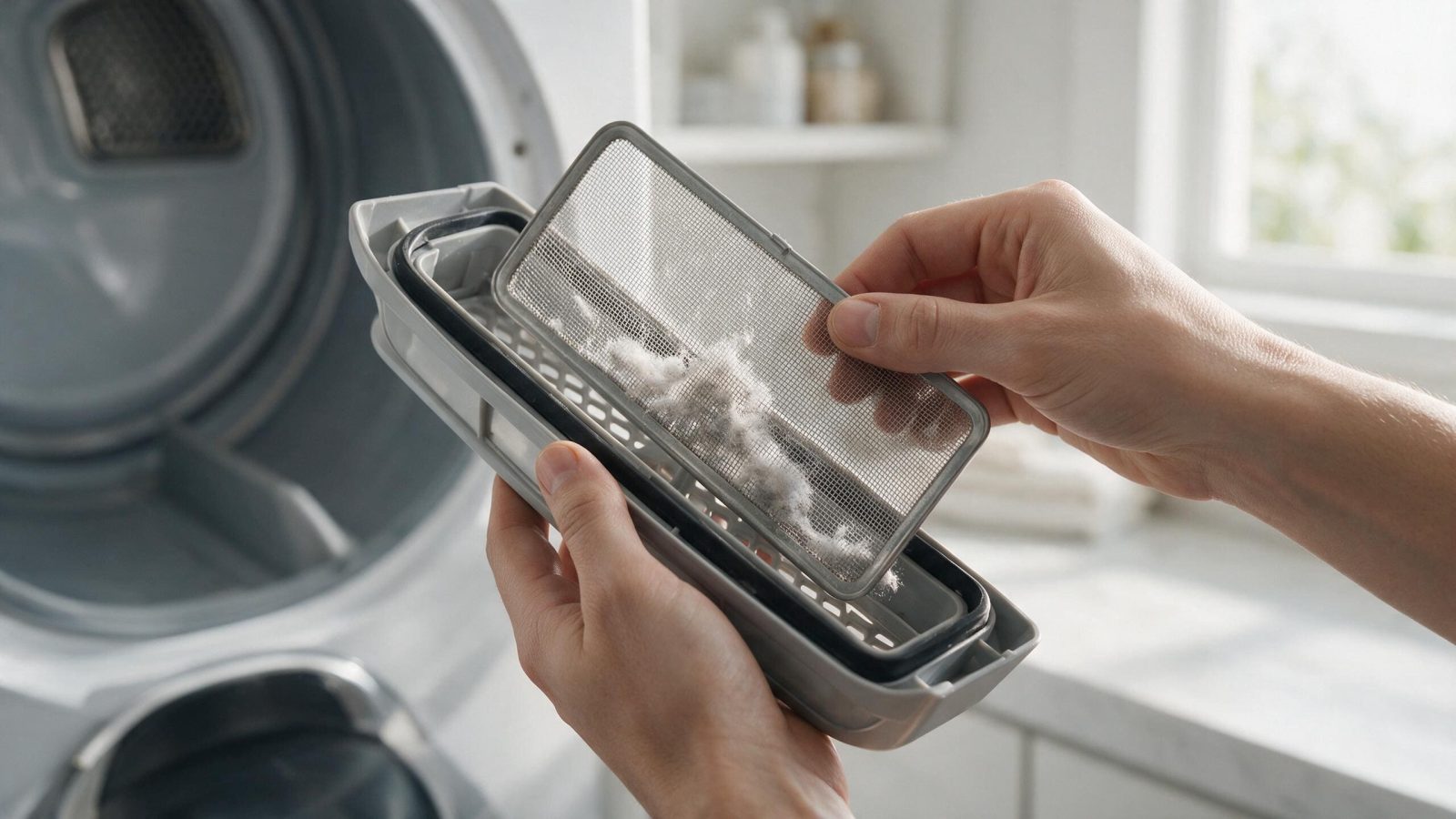
Clean the user-removable lint filter. A restricted filter reduces airflow and can increase drying time or temperature.
Reinstall it correctly before the next cycle.
The Bosch dryer manual read for this article says to clean the lint filter before or after each drying process, because a dirty one lengthens drying and increases energy use. If the lint filter indicator lights during a program, the program interrupts, and the manual says to clean the filter right away. For a badly clogged filter, it says to rinse it under warm running water and dry it thoroughly before putting it back. Lint also collects in the filter area, and the manual says a vacuum cleaner can remove it there.
Inspect the visible external duct and outside termination for restriction according to the installation guidance.
Do not crush flexible ducting behind the machine.
A long, restricted, or poorly installed exhaust path can make a healthy dryer perform badly.
| What you notice | What it can point to | What you can safely check |
|---|---|---|
| Drying time creeping up over weeks | A dirty lint filter or, on a condensation model, a heat exchanger that needs cleaning | Clean the filter and the filter area, then see whether drying time recovers |
| Lint filter indicator lights mid-program | The manual for one model says the program interrupts until the filter is cleaned | Clean the filter and restart the program |
| Dryer vented outdoors and slow regardless of filter | A restricted or poorly installed exhaust path | Look at the visible duct and outside termination without crushing flexible ducting |
| DR indicator on a condensation model | The manual for one model says water has not drained completely | Check the drain hose for kinks, restrictions, or blockage |
| Laundry ends damp after a clean filter | A sensor film or heat-exchanger buildup on a condensation model | Follow the manual’s cleaning steps for those user-serviceable parts |
Follow the model instructions for condensate containers, secondary filters, or user-accessible heat-exchanger areas.
Do not apply vented-dryer advice to a machine that does not use an external exhaust.
The manual for one Bosch condensation dryer says the heat exchanger needs periodic cleaning, recommended once per month under normal conditions and depending on load amount and type. It describes cooling the dryer first, putting a cloth under the maintenance flap, releasing the two locking levers, taking out the exchanger, and rinsing it with a jet of warm water, never hard or sharp objects, before drying it fully and reinserting it. The Bosch US support page adds that the condenser sits behind the cap at the maintenance flap and that you should unplug the dryer before cleaning the interior, the sensor, or the condenser.
Your model may be built differently, so follow your own manual for the exact steps and what counts as user-serviceable.
The same manual says a condensation dryer pumps condensate through a drain hose to a standpipe or drain, and that you should use only the supplied hose and keep the flow unobstructed. A kinked or blocked hose can therefore show up as a water-related message instead of a drying complaint. This is also why advice about outdoor ducts does not apply here: the moist air leaves as water, not as exhaust.
Room conditions matter as well. The manual lists an ambient temperature of 41 to 95 F as the recommended operating range and says low temperatures can prolong drying, so a dryer in a cold space can look slower than it is.
Maintenance is easier when you notice gradual change.
If drying time increases over several weeks, record whether cleaning restores performance. If it does not, the problem may have moved beyond routine maintenance.
A useful test of the trend is to clean the filter, filter area, and any user-serviceable condenser, then run the same load and program once. If drying time returns to normal, maintenance was the issue. If it does not, the cause has moved past routine care.
A recurring over-temperature or airflow code should not be cleared repeatedly.
Allow the dryer to cool, complete the correct maintenance, and request diagnosis if the warning returns.
For persistent slow drying, use Bosch Dryer Needs Two Cycles: Separate Airflow From Heating and Bosch Dryer Repair.
It is essential but not necessarily the whole airflow path.
Do not open internal service panels as routine homeowner maintenance.
Use the exact model page and owner documentation.
The manual for one Bosch condensation dryer recommends once per month under normal conditions, depending on load amount and type. Follow the schedule in your own manual.
The manual for one Bosch dryer says a severely dirty or clogged filter can be rinsed under warm running water and must be dried thoroughly before it goes back. Never put it back wet.
Bosch support pages say lint buildup makes the dryer take longer and use more electricity, so a clean filter helps both drying time and energy use.
Bosch front-load washer freshness depends on managing moisture and detergent residue. Clean user-accessible areas and let them dry.
Bosch dishwasher odor often starts where food residue and moisture remain. Clean user-serviceable areas and check whether the machine drains fully.
Cleaning a Bosch dishwasher filter is useful maintenance when the model allows it. Follow a simple process and avoid internal disassembly.
Share a few details and we’ll confirm an appointment. Prefer to talk? Call us and we’ll help right away.
Use the secure scheduler below to request your appointment.